


Traveling with Pets
Everything you need to know about traveling with pets
Being accompanied by your best friend can make your trip even more special!
However, just like their owners, pets also need to prepare adequately before boarding. Therefore, it is essential that you carefully read the rules and guidelines to ensure that your pet has a comfortable and safe experience. Additionally, to avoid unpleasant surprises, we recommend that you check in advance the transportation regulations of the selected airline. Each company has its own particularities, and the mandatory requirements may vary between domestic and international flights.
1
Dogs and cats
The boarding of pets depends on the presentation of certain documents and certificates. The following are required for domestic flights:
- Vaccination card with proof of polyvalent and rabies vaccines administered more than 30 days and less than 1 year ago;
- Health certificate issued by a veterinarian up to 10 days before the trip, ensuring that the pet is healthy and in good condition to travel.
2
Guide Dog
It must be transported free of charge, on the cabin floor of the aircraft, next to its owner and under their control, equipped with a harness and exempt from the use of a muzzle. The guide dog must be accommodated in such a way that it does not obstruct the aircraft aisle. In addition, the requirements of national health authorities and the destination country, when applicable, must be met, with the owner responsible for presenting documents proving the animal's training and identification, as well as providing the necessary food.
3
Native Wild Species
For the transportation of animals from the Brazilian fauna, an Animal Transit Guide (GTA) issued by a veterinarian authorized by the Ministry of Agriculture, Livestock, and Environment (MAPA) or by the state sanitary defense agency is required. In the case of these species, it is also necessary to prove that the animal was legally acquired by presenting the purchase invoice issued by a breeder or wildlife trader duly authorized by the competent environmental agency. In the absence of this document, a transportation license issued by the competent environmental agency must be presented.
4
Espécies silvestres exóticos
For travel with foreign wild animals, it is necessary to present the Animal Transit Guide (GTA) issued by a veterinarian authorized by MAPA or the executive body of sanitary defense in the states, along with the authorization from IBAMA. It is also necessary to prove the legality of the animal's acquisition through the purchase invoice issued by a breeder or trader of wild animals authorized by the competent environmental agency. If the invoice is not available, the transportation license issued by the competent environmental agency must be presented.
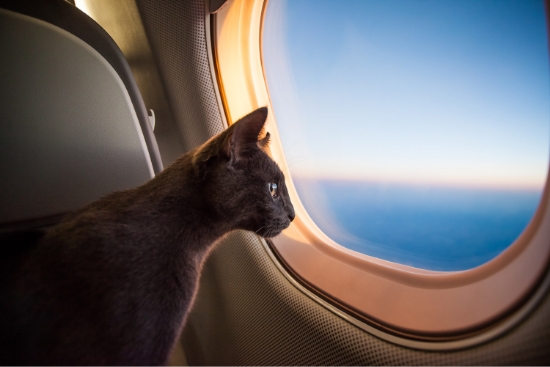
International flights with animals
To travel with your pet abroad, it is essential to be aware of some key information, such as the acceptance of the animal species in the destination country, mandatory vaccinations, and the issuance of the International Veterinary Certificate (IVC) by the Ministry of Agriculture, Livestock, and Supply (MAPA). The IVC is an important document that certifies the animal's good health and is required for it to enter another country. Be prepared and plan ahead to ensure a smooth and safe trip for you and your pet.
For information, consult the contracted airline or access the link below.
Questions and Answers
Airlines have a limited number of spots for transporting animals on each flight, which means your pet's transport is subject to confirmation. To ensure the reservation of the ticket, it is important to pay attention to some important information, such as the type of animal you wish to transport and the dimensions of the transport crate that will be used. Be aware of the requirements of the chosen airline.
Except for guide dogs, all pets must be transported in an appropriate carrier, respecting the maximum dimensions allowed in the cabin or the hold of the plane. Check with your airline for information on animal transport rules.
To ensure your pet travels comfortably in the carrier, it is recommended to start the adaptation process 15 days in advance:
- Leave the carrier open and accessible for the pet in a location inside the house. This way, it can become familiar with the environment.
- Offer meals and play with the animal inside the carrier, making the space comfortable.
- While the pet is in the carrier, close the door so it can get used to it. Gradually increase the time spent inside the carrier and move away so it also gets accustomed to your absence.
Tips for Traveling with Your Pet
For a peaceful journey, here are some tips that can make transporting your dog or cat easier: